

For six years, I’ve been quietly rehearsing the worst-case scenario, a disaster that never actually arrives.
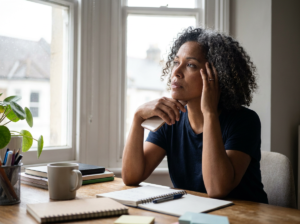
I run my own business. And for most of that time, there’s been a low hum running underneath everything I do. A quiet, persistent voice that says, “You’re going to lose this client.” And then the next one. And then it all falls apart.
I’d send an email and immediately imagine the cold reply that meant they were leaving. A client would take a few hours to respond, and I’d already written the breakup in my head. I’d replay conversations I’d had, searching them for the moment I must have messed everything up.
And here’s the thing that finally stopped me in my tracks.
None of it ever happened.
Not once. In six years.
Instead of losing clients, I kept growing. The disasters I rehearsed so faithfully, in such vivid detail, never came. I had spent years living inside catastrophes that existed nowhere except in my own mind.
The Disaster That Lived Only in My Mind
There’s a name for what I was doing. Psychologists call it “catastrophizing”; it is the habit of automatically assuming the worst possible outcome, often with very little evidence. And it turns out it’s not just a bad mental habit. It has a real, physical cost.
When your brain perceives a threat, a small almond-shaped structure called the amygdala sounds the alarm. It signals the release of stress hormones like cortisol and adrenaline, which raise your heart rate, tense your muscles, and prepare your body to fight or flee. This is the same system that would activate if you came face-to-face with a bear in the woods.
But here is the fascinating part and the part that explains so much about anxiety. Your brain runs this alarm not only for real, present dangers but also for anticipated ones. Brain imaging research has shown that the amygdala fires up in response to threats that aren’t actually dangerous in the moment; it reacts to the idea of danger, not just its reality.
Which means every time I vividly imagined losing a client, my brain was responding as though it were happening right now. My body was bracing for an attack that lived only in my imagination.
The problem is, I wasn’t doing this once in a while. I was doing it constantly. So my body was living in a near-permanent state of low-grade emergency over things that weren’t actually happening.
That’s exactly what it felt like, too. The replayed conversations. The tension I carried without realizing it. The quiet anxiety humming under my days. I was physically paying the price for catastrophes that were never real.
Why Your Brain Defaults to the Worst-Case Scenario
Here’s what makes this so important to understand: your brain isn’t broken for doing this. It’s doing exactly what it evolved to do.
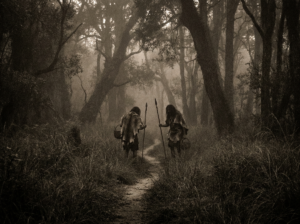
For most of human history, assuming the worst kept us alive.
Imagine one of our ancestors hearing a rustle in the bushes. The one whose brain assumed “it’s just the wind” and the one whose brain assumed “it’s a predator” faced very different odds. If you assumed the worst and ran, and there was nothing there, you lost nothing but a little energy. But if you assumed the best and stayed, and there was something in the bushes, you didn’t get a second chance.
So the brains that survived, the ones that passed their wiring down to us, were the ones that defaulted to danger. Assuming the worst was simply the safer bet. Catastrophizing wasn’t a flaw. It was protection.
The problem is that most of us are no longer running from predators. The “threats” we face now are unanswered emails, awkward conversations, or, in my case, the fear of losing a client. But our brains haven’t caught up. They still run the same ancient survival software in a world that rarely calls for it. So the very mechanism that once kept our ancestors alive now just keeps us anxious, sounding the alarm over things that were never going to hurt us.
Once I understood that, I stopped being so hard on myself. My brain wasn’t malfunctioning. It was just running an old program in a new world.
The Brain Can Change
And here is what gave me genuine hope.
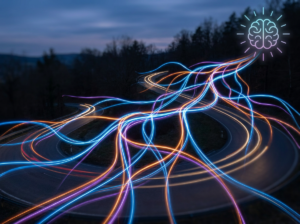
The brain is not fixed. It has a quality scientists call “neuroplasticity”, the ability to reorganize itself by forming new connections based on what we repeatedly think, feel, and do. The mental patterns we practice most become the ones our brains reach for most easily.
Which means that all those years of rehearsing the worst case taught my brain to find the worst case faster. I had made catastrophizing my most well-worn road, simply through repetition.
But that same quality works in the other direction. If I built that pathway through practice, I can build a different one the same way. I can practice a new default. And with enough repetition, the new road can become the familiar one.
I’m not stuck with this. None of us is.
Choosing a Better Story
So I’ve started an experiment with myself.
Every time I catch my mind reaching for the worst case, you’re going to lose this client… I stop. And I deliberately, consciously build the opposite. What if this goes well? What if they’re happy? What if this grows into something bigger than I imagined?
At first, it felt unnatural. Almost silly. My brain is so practiced at disaster that hope feels like a language I don’t speak fluently. But that’s exactly the point. I’m not fluent in it yet. I’m learning. And every time I choose the better scenario, I’m walking that new road one more time.
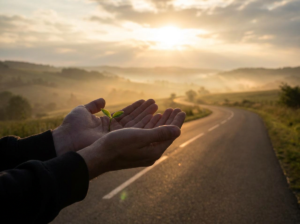
I’m genuinely curious to see how far this can take me. If years of imagining the worst kept me tense and braced and small, what happens if I spend the next stretch of my life imagining and working toward the best?
What does my life look like if I stop rehearsing my own downfall?
I don’t have the full answer yet. I’m right in the middle of finding out. But six years of evidence have already taught me one thing for certain:
The worst case is the story I tell myself the most. And it’s rarely the story that comes true.
So I’m going to start telling a better one. This is part of the same inner work I’ve been writing about lately — read more here.🌱
What’s a worst-case scenario you’ve rehearsed that never actually happened? I’d love to hear it in the comments.